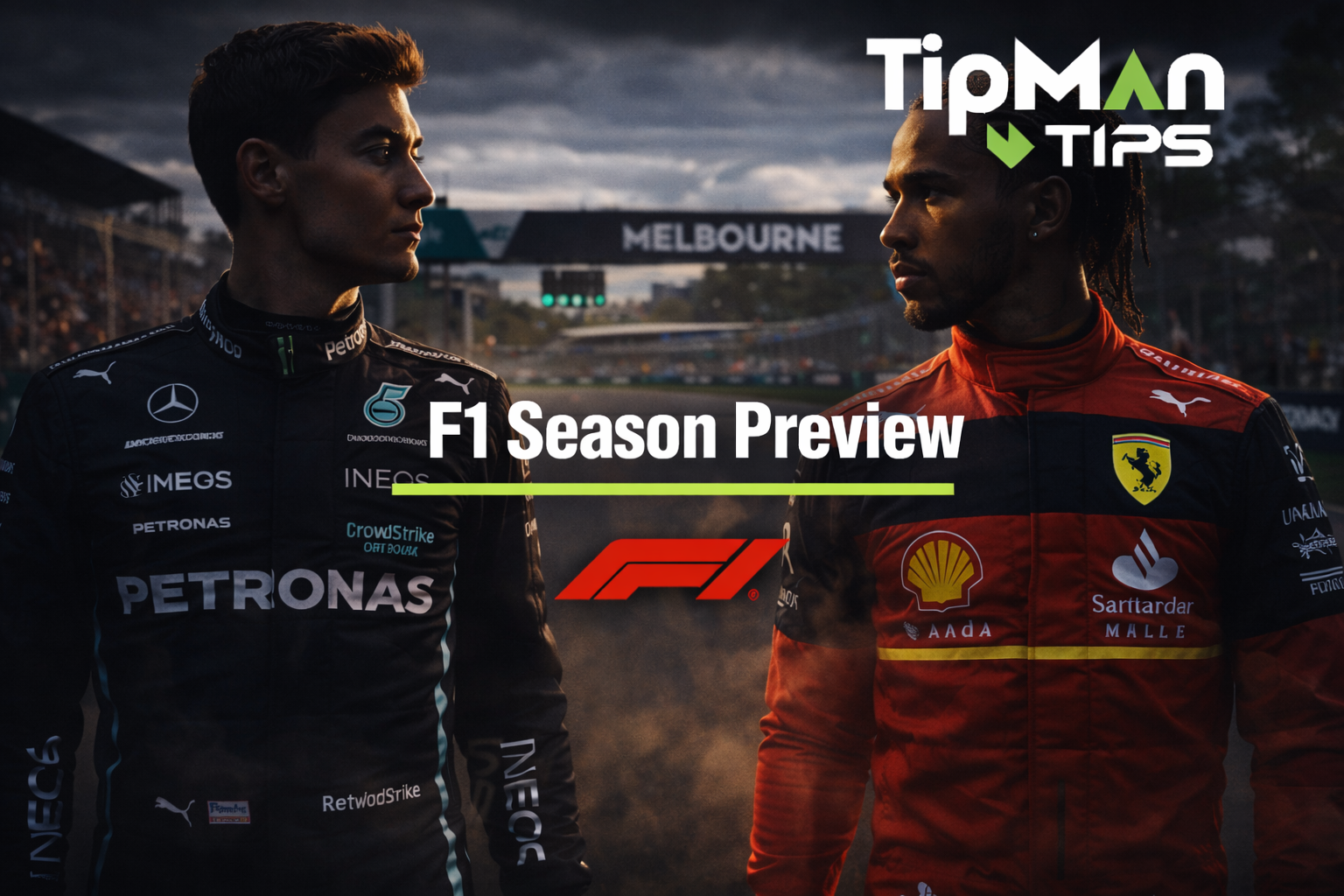


Formula 1 Season Preview – 2026

21289

Tyler Smith

An enthusiastic sports writer with a passion for Football, American Sports and Formula 1, bringing sharp insight and informed betting analysis to every weekend.

Bet £10 Get £50 in Free Bets

New customers only. Register, deposit with Debit Card, and place first bet £10+ at Evens (2.0)+ on Sports within 7 days to get 3 x £10 in Sports Free Bets & 2 x £10 in Acca Free Bets within 10 hours of settlement. 7-day expiry. Eligibility exclusions & T&Cs Apply.

Formula 1 Season Preview - Intro


F1 Australian GP Winner - George Russell
1.88/1

F1 Drivers Championship Winner - George Russell
15/8

F1 Drivers Championship Winner - Charles Leclerc
5/1

TipMan Premium - The UK's #1 Betting Tip Subscription Service

Join over 2,300 savvy bettors who are already profiting from expert football and horse racing tips. Tipman Tips offers you unparalleled insights, backed by a tipster team with a 9-year winning track record.

Teams, Drivers and Breakdown:

🏁 McLaren

Drivers:
Lando Norris – The reigning World Champion and McLaren cornerstone, Norris has emerged as one of the sport’s most exciting talents. Known for his consistency, speed and emotional intelligence in racing, he enters 2026 seeking to defend his title and build on McLaren’s recent resurgence.
Oscar Piastri – A young superstar in the making, Piastri quickly made his mark with McLaren, showing maturity beyond his years. He is a formidable racer with an impressive junior career and has already notched several race wins and podiums.


🏎️ Red Bull Racing

Drivers:
Max Verstappen – A four-time World Champion and one of the most dominant drivers of his generation, Verstappen is still hungry for more titles. He combines raw speed with fierce race craft and will be a central contender in 2026.
Isack Hadjar – Promoted from the junior ranks after strong performances with Racing Bulls, Hadjar is a young French talent with a reputation for aggressive racing and quick learning. 2026 will be his first full season with the senior Red Bull squad.


🏎️ Ferrari

Drivers:
Charles Leclerc – A long-time Ferrari driver and former race winner, Leclerc is one of Formula 1’s most gifted qualifiers and racers. With nearly a decade of experience, he remains a key pillar for Ferrari’s hopes this season.
Lewis Hamilton – The seven-time World Champion needs little introduction. Hamilton’s legacy towers over the sport, and his switch to Ferrari has rewritten the headlines. Although his first season with the Scuderia was challenging, expectations are high for him to push back to the sharp end.


🏁 Mercedes

Drivers:
George Russell – In his years with Mercedes, Russell has matured into one of F1’s most reliable and fast drivers. With multiple years at the Silver Arrows, he’s expected to vie for wins and podiums.
Andrea Kimi Antonelli – One of the sport’s most talked-about young prospects, Antonelli impressed in his rookie season. With a near-flawless junior résumé, he brings youthful speed and fearlessness to Mercedes.


🏎️ Williams

Drivers:
Alex Albon – A seasoned campaigner with experience at Red Bull and Williams, Albon’s journey has been defined by resilience and growth. His consistency has helped Williams punch above its weight.
Carlos Sainz – A former Ferrari driver, Sainz brings experience and speed to Williams. In his debut season with Grove, he scored multiple podiums and solidified his reputation as a dependable points scorer.


🏁 Racing Bulls

Drivers:
Liam Lawson – A young and aggressive racer from New Zealand, Lawson has battled through Formula 2 and impressed enough to retain his seat with Racing Bulls. His adaptability will be key this season.
Arvid Lindblad – The youngest driver on the grid at just 18, Lindblad arrives as rookie sensation. A standout in junior categories, he has been earmarked as a star for the future.


🏎️ Aston Martin

Drivers:
Fernando Alonso – One of the most experienced drivers on the grid, Alonso combines tactical brilliance with fierce competitiveness. Even after more than two decades in F1, he remains a formidable presence.
Lance Stroll – A capable racer with years of F1 experience, Stroll brings valuable technical feedback and consistency, helping Aston Martin develop its package.


🏁 Haas

Drivers:
Esteban Ocon – A veteran French driver with a Grand Prix win and strong race craft, Ocon continues to add depth and leadership to Haas as one of the more experienced midfield racers.
Oliver Bearman – A promising young British talent, Bearman made waves with Haas after stepping up from junior categories in 2025, showcasing speed and potential beyond his years.


🏎️ Audi (formerly Sauber)

Drivers:
Nico Hülkenberg – The experienced German racer famously claimed his first podium in 238 starts — a testament to persistence and skill. His role at Audi brings leadership to the developing works team.
Gabriel Bortoleto – The young Brazilian continues his F1 progression, having shown promise with solid results in 2025. He aims to build on that momentum in Audi’s first full season.


🏁 Alpine

Drivers:
Pierre Gasly – A veteran French driver with a Grand Prix victory and years of midfield experience, Gasly leads Alpine with calm precision.

Franco Colapinto – A rising young driver from Argentina, Colapinto brings fresh energy to Alpine. Though still early in his F1 career, he has shown flashes of speed and maturity.


🏎️ Cadillac (New Team)

Drivers:
Sergio Perez – A multiple-race winner and former Constructors’ Championship contributor with Red Bull, Perez returns to the grid with Cadillac bringing veteran savvy.
Valtteri Bottas – A seasoned Finn with a decade-plus in F1, Bottas was a consistent podium contender during his years with Mercedes. His comeback adds depth and experience to Cadillac’s debut campaign.

TipMan Premium - The UK's #1 Betting Tip Subscription Service

Join over 2,300 savvy bettors who are already profiting from expert football and horse racing tips. Tipman Tips offers you unparalleled insights, backed by a tipster team with a 9-year winning track record.

"Excellent tips. Keep it going Tipman. No better tipsters around..."
"I have joined Tipman services over 1 month and 5..."
"Although the service you lads provide is quality I kind..."
"Good tips"
"Without doubt the best tipping service out there 100% recommend"
"Great bunch of tipsters with a great consistent profit"
"So far so good!"
"Been with Tipman Tips for years, good profitable tipsters."
"Not sure yet, have't been with them long enough, but..."
"Banging tips make more than the subscription every month don’t..."
What are the regulation changes for the 2026 season?

A Brand-New Technical Era in Formula 1 📊

The 2026 season isn’t just another step forward — it’s a major re-write of the sport’s technical rulebook, with the FIA aiming for faster racing, better overtaking, greater sustainability and closer competition. After years of relatively stable regulations, this overhaul affects nearly every part of the car — from the engines to the aerodynamics, the fuels, and even how drivers manage energy on track.


🔋 Power Units: A Closer Step to Road Technology

The biggest changes begin with the power unit — the hybrid engine that has defined Formula 1’s modern era. While the basic architecture remains a 1.6-litre V6 turbo, the hybrid component has been completely reconceived:

  • Electric power and internal combustion are now roughly balanced 50/50 — a much greater emphasis on electrification than before.

  • The MGU-H unit — which used to harvest energy from exhaust heat — has been removed, a simplification designed to cut complexity and cost while encouraging more manufacturers to join.

  • The MGU-K (which captures energy under braking) has been massively boosted — nearly tripling its output and energy harvesting capability, meaning electrical power plays a huge role in both speed and strategy.

  • All cars will now run on 100% advanced sustainable fuels, made from non-fossil sources — part of F1’s aim to reach net zero carbon by 2030.

Despite these shifts, total power remains over 1,000 hp, and fuel efficiency improves as overall consumption drops, with cars carrying significantly less fuel than in previous years.

What this means for racing: drivers and teams will need to master energy harvesting and deployment just as much as pure throttle control — making strategic use of electrical power a defining skill.


🚗 Aerodynamics & Chassis: Smaller, Lighter, Smarter

The shape and size of the cars themselves have been changed:

  • Cars are smaller and about 30 kg lighter than before, making them more agile and easier to drive closely.

  • Downforce has been intentionally reduced by around 15–30%, and drag has dropped significantly — helping reduce turbulent air and encouraging cars to follow each other more closely through corners.

  • The floor and bodywork have been simplified, with narrower front and rear tyres helping reduce resistance.

But the most eye-catching change is active aerodynamics — movable front and rear wings now replace the traditional fixed wings and the Drag Reduction System (DRS). These systems allow drivers to switch between high-downforce and low-drag configurations, adapting the car’s behaviour depending on whether they’re attacking, defending or negotiating corners.


⚡ New Racing Modes: Overtake & Boost

One of the biggest talking points for fans is how overtaking — once dominated by DRS — will work under the new rules:

  • Overtake Mode replaces DRS as the primary overtaking aid. When a driver is within one second of the car ahead at certain detection points, they get a temporary burst of extra electrical power, helping them close in and pass.

  • Drivers also have a manual “Boost” button on the wheel, allowing them to deploy stored electrical energy strategically — for defending, attacking, or power on exits.

  • Recharging the battery — through braking, coasting or specific driving techniques — becomes an integral part of race strategy.

This shift places more tactical control in the drivers’ hands, rather than relying on automatic systems, and could change how races unfold fundamentally.


🛞 Tyres, Safety and Other Practical Tweaks

Some additional changes will be noticeable even to more casual viewers:

  • The wheel rims stay at 18 inches, but tyre widths have narrowed front and rear to reduce drag and weight.

  • Safety lights and structures have been updated with new signals to indicate battery status and tyre info — improving visibility and communication on track.

These tweaks, while less flashy, contribute to overall racing quality and help ensure that the cars remain both safe and performance-oriented.


🏎️ Why It Matters

All of these changes are part of a broader vision: to make Formula 1 relevant for the future, more exciting to watch, and more connected to real-world automotive technologies. The regulations are designed to reward strategic thinking, driver skill in energy management, and efficient engineering, not just raw power. As teams and drivers adapt throughout 2026, we may well see new performance hierarchies — and perhaps even the most dramatic title fight in recent memory.

TipMan Elite - Our most exclusive value betting service

Join a limited group of elite bettors enjoying our most profitable service to date. TipMan Elite uses state-of-the-art, in-house betting software and a precision value betting strategy to deliver consistent long-term success.

What did we learn from Pre-season testing?

Pre-season testing ahead of the 2026 campaign has given us our first meaningful glimpse into how Formula 1’s new era is beginning to take shape — and while lap times always come with caveats, clear trends have emerged. With brand-new power units, active aerodynamics and an increased reliance on electrical deployment, teams arrived knowing that reliability would be just as important as outright speed. Three days of running suggested that some outfits have adapted seamlessly to the regulation reset, while others still have major correlation and drivability questions to answer heading into the season-opening Australian Grand Prix.

The headline takeaway has been how differently teams have interpreted the new rules. Some cars appear stable and mechanically compliant, prioritising consistent long-run pace and smooth energy harvesting. Others have chased peak performance, producing eye-catching single laps but showing signs of instability under braking or mid-corner rotation. The smaller, lighter chassis have made the cars look more agile, but drivers have openly discussed how sensitive they are to ride height and aerodynamic mode switching. Managing the transition between low-drag straights mode and high-downforce cornering configuration appears to be one of the biggest early learning curves.

Power unit performance has also been a major talking point. With electrical deployment now playing a far greater role, we’ve seen visible differences in straight-line speed consistency — some cars look rapid early on a straight before tapering off, suggesting aggressive early deployment, while others build speed progressively. Energy recovery under braking has become crucial, and drivers who can manage lift-and-coast phases without losing track position could gain a strategic edge. Encouragingly for the sport, most teams completed high mileage totals, suggesting the feared reliability crisis hasn’t materialised — but subtle cooling and battery management issues were evident in hotter afternoon sessions.

Long-run data has arguably been more revealing than headline lap times. On heavier fuel loads, a small group of teams consistently delivered strong pace without dramatic tyre degradation, hinting at well-balanced packages suited to race conditions rather than qualifying glory. Meanwhile, a few traditionally front-running teams appeared more inconsistent across stints, suggesting they may still be fine-tuning mechanical grip or energy deployment calibration. Importantly, midfield gaps looked tight — potentially setting up one of the most competitive constructor battles in years.

Heading into Melbourne, the competitive picture feels intriguingly open. There appears to be no runaway favourite — at least not yet — and the unique characteristics of Albert Park will provide a very different test to the smoother pre-season circuit. The stop-start nature of the Australian layout will place huge emphasis on traction, braking stability and efficient electrical harvesting. With overtaking now shaped by the new boost system rather than DRS, racecraft and timing will be under the spotlight immediately.

Ultimately, what testing has shown us is potential — but not certainty. The regulation reset has compressed the field more than many expected, and development rates over the opening triple-header could dramatically alter the early pecking order. As the paddock heads to Australia, confidence varies up and down the grid — but one thing is clear: the 2026 season begins with genuine unpredictability, and that alone makes Sunday’s opener one of the most anticipated in years.

F1 Australian GP Winner - George Russell
1.88/1

F1 Drivers Championship Winner - George Russell
15/8

F1 Drivers Championship Winner - Charles Leclerc
5/1

Tipmans Early Predictions

George Russell – Drivers Champion:

If pre-season testing is anything to go by, Mercedes have emerged as the early benchmark in Formula 1’s new regulatory era. The Silver Arrows look like a team that not only understood the technical brief of 2026 — but anticipated it. Their car has appeared stable across aerodynamic modes, efficient in energy deployment, and most importantly, consistently quick over long runs. In a season where electrical harvesting and deployment play a decisive role, Mercedes seem to have struck the cleanest balance between combustion power and hybrid output.

One of the clearest indicators of their strength has been drivability. The 2026 cars are inherently more sensitive due to active aerodynamics and lighter chassis dimensions, yet the Mercedes has looked composed under braking and predictable through direction changes. Drivers have reported minimal instability when switching between low-drag and high-downforce configurations — a sign that the aerodynamic platform is well integrated rather than reactive. That stability matters enormously at tracks like Melbourne, where traction zones and braking phases dominate lap time.

Crucially, Mercedes’ power unit appears extremely refined. The removal of the MGU-H and the increased reliance on the MGU-K system has forced teams to rethink energy strategy, and Mercedes seem ahead in harvesting efficiency. Their straight-line speed has looked strong without dramatic drop-offs late in the straights, suggesting controlled, sustainable electrical deployment rather than short bursts. In a championship where battery management could define races, that composure is a huge early advantage.

All of this feeds directly into why George Russell is being widely tipped as favourite for the Drivers’ Championship. Russell enters 2026 as the established team leader and is arguably at the peak of his career. Over the past few seasons, he has matured into one of the grid’s most complete drivers — fast over one lap, calm under pressure, and tactically sharp. If Mercedes truly have the most rounded package, Russell’s consistency could make him the man to beat. In a new era where adaptability is key, his analytical approach and technical feedback may prove just as valuable as raw speed.

Ferrari – Hamilton/Leclerc Champion:

While Mercedes may have shown early consistency, Ferrari have quietly positioned themselves as potential championship challengers. Their 2026 challenger appears to prioritise outright performance, particularly in qualifying trim, where the car has shown flashes of exceptional pace. If that one-lap speed translates into regular front-row starts, Ferrari could control races strategically — especially under the new overtaking format.

Ferrari’s power unit also appears aggressive in deployment. Observers noted strong initial acceleration phases and impressive mid-straight pull, suggesting that the Scuderia are confident in pushing the limits of the enhanced electrical systems. That approach carries risk — particularly regarding thermal management and long-run stability — but it also signals ambition. In the early phase of a regulation reset, bold engineering often pays dividends if reliability holds.

Aerodynamically, Ferrari seem to have opted for a slightly higher downforce philosophy compared to some rivals. While that may compromise peak straight-line efficiency at certain venues, it could offer superior cornering grip and tyre preservation — particularly valuable at technical circuits. In a season expected to be tightly contested, tyre management across race stints may prove decisive, and Ferrari’s balance through medium-speed corners has looked especially strong.

Then there’s the driver factor. With Charles Leclerc’s raw qualifying brilliance and Lewis Hamilton’s championship pedigree, Ferrari arguably possess the most formidable driver pairing on the grid. Leclerc’s ability to extract peak performance from a car over one lap could secure crucial track position, while Hamilton’s racecraft and experience managing energy systems across hybrid eras cannot be underestimated. If the car remains within striking distance of Mercedes on outright pace, Ferrari absolutely have the driver depth to sustain a title challenge across a long season.

In short, Mercedes may look like the early all-round package — but Ferrari’s ceiling could be just as high. If development gains come quickly and reliability matches ambition, the Scuderia could transform early promise into a genuine championship fight. And in a brand-new technical era, momentum can shift faster than anyone expects.

Join the #1 Telegram Betting Channel — Profitable Daily Football & Horse Racing Tips

No fluff. No gimmicks. Just solid tips — delivered straight to you.

Where to Watch the Formula 1 Season in 2026

United Kingdom

📺 Live Coverage

  • Sky Sports F1 is the exclusive live broadcaster of Formula 1 in the UK for the 2026 season, showing every practice session, qualifying, sprint and race live.
    • You can watch via Sky TV if you have a subscription.
    NOW (formerly NOW TV) also offers flexible 24-hour or monthly pass options to access the live Sky Sports F1 feed without a long-term contract.

📺 Free-to-Air & Highlights

  • Channel 4 will broadcast free highlights from every race weekend, typically showing qualifying and race highlights a few hours after the conclusion of the live event.

  • Channel 4 will also show the British Grand Prix live including practice and qualifying — a special free-to-air event for UK fans.

📱 F1 TV Options

  • F1 TV Pro (full live streaming) is not available in the UK due to Sky’s exclusive rights, though fans can use F1 TV for live timing, data and archive content.


🇺🇸 United States & North America

  • Apple TV is now the exclusive home of Formula 1 in the United States starting in 2026, following a major multi-year rights deal.
    • It will broadcast every practice, qualifying, sprint and race live through the Apple TV app.
    • Some races or sessions may be available for free without a full subscription.


🌍 International Viewing — Worldwide

📺 Africa & Select Regions

  • In many African countries, broadcasters like SuperSport or local sports networks cover Formula 1 — often included in sports packages. (Availability depends on region; check local listings.)

📺 Asia

  • beIN SPORTS holds the exclusive broadcast rights in several Asian territories, showing live coverage of all sessions throughout the season.

📺 Brazil

  • Globo returns as Formula 1’s broadcaster in Brazil in 2026, offering a combination of free-to-air and pay TV coverage.

📺 Latin America & Caribbean

  • ESPN (and associated networks like Fox Sports in some countries) broadcasts F1 across much of Latin America and the Caribbean.

🌐 F1 TV Pro

  • In countries where local rights have not been sold exclusively, F1 TV Pro can be used to stream every session live, with onboard cameras, team radio and additional features — but its availability varies by region due to rights restrictions.


📱 Streaming & Online Options

  • F1 TV Access/Pro: A worldwide official F1 streaming platform (availability depends on region). In some countries it offers full live coverage; in others, only data, highlights and delayed replays.

  • Broadcaster Apps: Many rights holders (e.g., Sky, beIN SPORTS, ESPN) have companion mobile or streaming apps which let subscribers watch live on phones, tablets or connected TVs.


📍 Summary — Quick Reference

Region Primary Live Option Free Highlights Option
UK Sky Sports F1 Channel 4 (highlights + British GP live)
US Apple TV ✔ Some sessions free via Apple app
Asia beIN SPORTS Depends on country
Brazil Globo / SporTV ✔ Globo free broadcasts
Latin America ESPN / Fox Sports 🚫 Not typically free
Other countries F1 TV Pro (where available) Varies
Explore more with Tipman
  • Free Football Betting Tips – Daily football tips, accumulators, and previews across the Premier League, Champions League, EFL, and Europe’s top leagues.

  • Free Horse Racing Tips – Today’s NAPs, Lucky 15s, ITV Racing previews, and big-race festival insights.

  • Latest Sports News & Previews – Stay ahead with the latest previews, betting stats, and multi-sport coverage from across the world of sport.

  • Free Bets & Bookmaker Offers – Unlock the best free bet deals, enhanced odds, and bookmaker promotions to maximise your betting value.

  • Premium TipMan Subscriptions – Upgrade to Premium and access exclusive betting strategies, expert tips, staking plans, and profit-tracking tools from the TipMan team.

Free Bets & Offers

Make sure to check our Free Bets section for the latest sign-up offers to use on the match. Many UK bookies are running bet £10, get £50 or risk-free first bet offers that are ideal to pair with tonight’s builder.

Bet £10 get £40 In Free Bets

New UK customers. Min £10 first deposit. Place a bet of £10 at min odds of 2.0 and get £40 in Free Bets within 48 hours. Restrictions apply. Full T&Cs apply, 18+. BeGambleAware.org.

F1 Australian GP Winner - George Russell
1.88/1

F1 Drivers Championship Winner - George Russell
15/8

F1 Drivers Championship Winner - Charles Leclerc
5/1

Join TipMan Premium Today

Take your betting to the next level with TipMan Premium. Trusted by thousands of members for profitable football and horse racing tips every day. Get expert analysis, exclusive offers, and insider strategies proven to boost your winning edge.

  • Daily Football & Racing Tips
  • High-Value Accas & Multiples
  • Track Record of Proven Profit
Join Tipman Premium Now
Want More Daily Tips?
Want more tips? The TipMan team will be updating the website each evening with the next day’s tips across these betting markets:

BET £5 GET £30

#Ad. 18+, GambleAware, Full T&Cs Apply.
TipMan Tips Icon
TipMan Tips
Sports Betting Tips
×